Arab Immigrants and the Camel Drives
The presence of camels in the U.S is connected to the immigration of Arab men to the U.S Southwest as camel handlers, though soon after the projects spearheaded by the War Department fell apart in roughly 10 years and the men who came to the U.S would have to figure out what their plans would be. A notable example is that of Hadji Ali (AKA: Philip Tedro, Hi Jolly) who had to change his job soon after the Wagon Road was disbanded due to a loss of funding and other pack animals not getting along well with camels. The stories of Arab immigrants who came to handle and teach Americans how to work with them all take different forms with some happening here in New Mexico.
Relationship of experiments in logistics and migratory work:
This story starts with officials and wealthy business owners thinking about how to optimize logistics in the newly colonized west and more efficiently transport cargo. In Virginia City (presumably Nevada) the ground was so sandy and the weather so hot that vehicles couldn’t have surrounding infrastructure built and mules couldn’t withstand the climate at all. After camels were brought over, mostly from Asia, significant improvements were seen as they needed minimal effort to be properly hydrated and fed, being able to eat brush and weeds while carrying 200 to 300 pounds of ore perfectly fine. Jefferson Davis, giving a report on the usage of camels in America to the United States Secretary of War, found the regions in which camels were commonly used to be “corresponding closely” to the southwest including “portions of Texas, New Mexico and California…”. And Edward Beale (with his own camel caravan) mentioned going all the way from Arkansas, through New Mexico, and reaching the Colorado river. Where this intersects with migratory work begins with Davis saying: “As to the difficulty of managing the camel… none but an Arab could do it…” as handlers were included alongside the camels that came from Asia.1
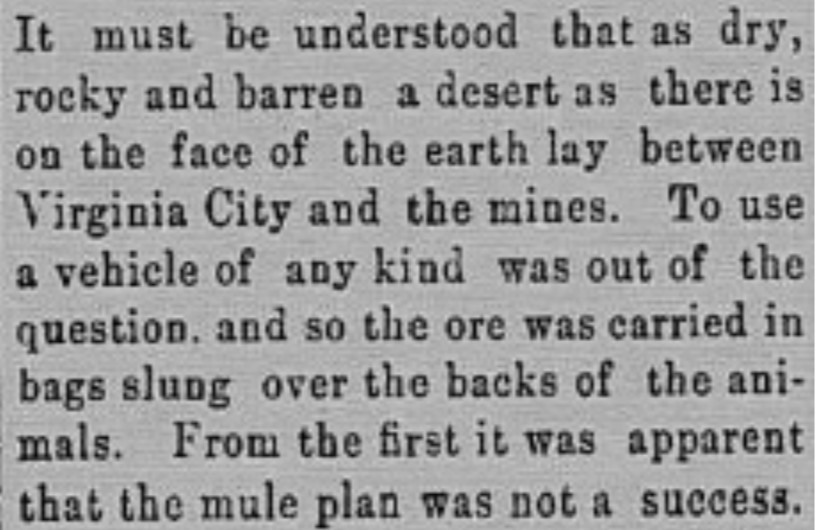
The lack of efficacy of mules and inability of vehicles to traverse the unforgiving landscape pushed mine operaters to find a new solution. Source: Last Native Camel Killed. The Anderson Intelligencer. March 15, 1899.
Hadji Ali and colonial immigration:
Hadji Ali, like the other men in his group, were recruited in the Ottoman empire and brought to the U.S alongside camels, landing shore in 1856. From there, he worked in a variety of jobs sometimes with the Army and sometimes not. Some of the jobs he had include but are not limited to: camel driver, delivery driver, Army scout, saddle maker, prospector, miner, and so on. His work with the Army was an on and off again ordeal and because of this never got a military pension only exacerbating his poverty in old age. Hadji Ali is an example of how the colonialism of the U.S west had employed underpaid racialized immigrants as a means of expanding the colonial project. 2
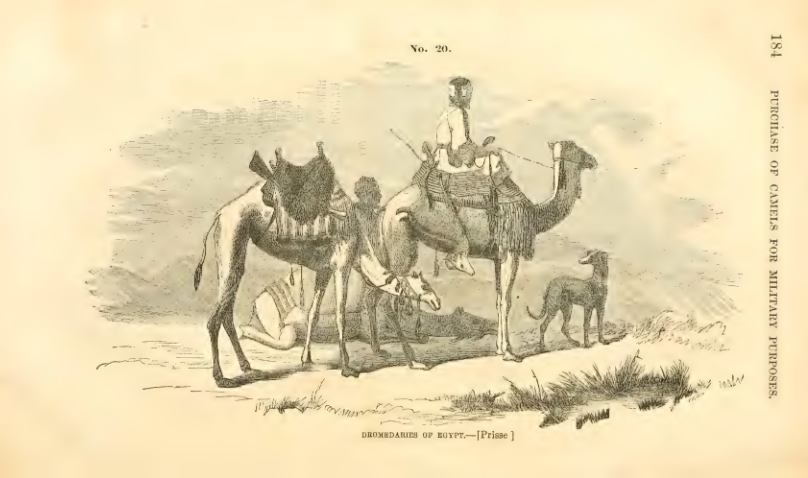
An example of what a camel drive may look like. Source: United States Secretary of War, Jefferson Davis. Information Respecting the Purchase of Camels for the Purpose of Military Transportation. Washington D.C: A. O. P. Nicholson, printer. March 15, 1899. 184
Arab immigrants and transient relationships:
As we saw in the paragraph on Hadji Ali, much of what defined the relationship with work for Arab immigrants in the southwest was transience. One story tells of a recently immigrated Arab man who had a dissatisfactory job working as a ditch digger and happened upon a zoo walking home. He saw a man try to move a camel out of its pen for cleaning and it wouldn’t budge no matter what. The Arab man began to sing to the camel and got it to move to a different pen so the previous could be cleaned. On the spot the zookeeper offers the Arab man a job for his ability to so easily move the camel. Arab immigrants and the systems around them often change on the fly in unexpected circumstances. 3
An Immigrant’s relationship the operation of their lives:
Much of what has defined the immigrant experience here has been circumstances and how that definition has come from the relationship of immigration and the economy. The ups and downs of the economy intertwine themselves with the lives of immigrants. The feast and famine nature of Hadji Ali’s career with the Army is an example of the inconsistent revenue stream they were getting. The beginning of the civil war then was his Potato Famine. Limitations from racialized assumptions as workers with specific ability and no opportunities outside of them cements the economic relationship.
-
Last Native Camel Killed. The Anderson Intelligencer. / United States Secretary of War, Jefferson Davis. Information Respecting the Purchase of Camels for the Purpose of Military Transportation. Washington D.C: A. O. P. Nicholson, printer. March 15, 1899. 18, 21 / United States Congress. House, and United States War Department. Washington, DC: U.S. Government Printing Office. Wagon road – Fort Smith to Colorado River. Letter of the Secretary of War, transmitting the report of Mr. Beale relating to the construction of a wagon road from Fort Smith to the Colorado River. March 9, . – Laid upon the table and ordered to be printed. 1860. 1, 2 ↩
-
Razek, R. D. The Other Settlers: Arabs in the American West. UC Santa Barbara. 2022. 56-63 ↩
-
Nabhan, Gary Paul. CAMEL WHISPERERS: Desert Nomads Crossing Paths. The Journal of Arizona History 49, no. 2. 2008. 97 ↩